
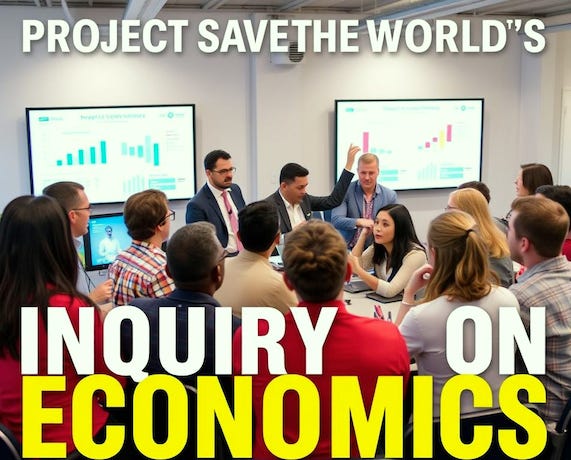
Join Our Economics Inquiry – Starts June 24!
This is one small planet with a lot of ambitious inhabitants. Are there enough resources to go around? Can we feed all those hungry people, yet incentivize creative workers?
Please join us on June 24th for the first of Project Save the World’s deliberations in our “Public Inquiry on Economics.” We will meet one hour on Wednesdays for five consecutive weeks at 4 pm Eastern (Toronto) time. We are waiving fees this time but applicants must register and be conversant in English. Read this syllabus and, if it interests you,register by clicking the “details” button on the pop-up window of our website:
https://tosavetheworld.ca
PROGRAM
Before each weekly meeting, participants spend about two hours reading some the articles footnoted below, which are accessible by browser.

First Session, “Economic Sustainability as a Key Challenge for our World”
June 24, 2026 at 4 pm Eastern (Toronto) time/(9:00 PM UTC) https://zoom.us/j/9108970203.
Estimates suggest Earth can sustainably support about 2 to 3 billion people if everyone lived like the average Western middle class. At this consumption level, humanity requires roughly 3 to 5 times the resources the planet can naturally regenerate in a year. [1, 2, 3, 4]
The gap between current population and sustainable capacity at Western standards is driven by several key metrics:
The Ecological Footprint: An average North American requires about 8 to 10 global hectares to sustain their lifestyle. If the entire global population did this, it would require five earths to support humanity. [1, 2]
Resource Consumption: The average Western middle-class citizen consumes roughly 3 times the subsistence level of food and over 200 times the subsistence level of clean water. [1, 2]
Scientific Consensus: According to multi-decade ecological carrying capacity models, humanity is significantly in “overshoot,” meaning we are depleting natural capital faster than it can recover. [1, 2, 3]
Carrying Capacity: The maximum population Earth can sustain ranges from 10 to 12 billion with current technology. This “carrying capacity: is not fixed; it shifts dramatically based on human consumption habits, agricultural efficiency, and how equitably resources are distributed worldwide.
Key Variables Affecting Carrying Capacity
Diet and Agriculture: Estimates o Earth’s absolute limits swing wildly depending on how we eat. I everyone adopted a primarily grain-based diet and we used all available arable land for intensive farming, the planet could theoretically stretch t support 30 billion people or more. However, this leaves little to no room for livestock or biodiversity.
Consumption and Equity: Resource consumption is profoundly unequal. For example, fi the entire global population consumed resources at the level of the average developed country, the Earth could only sustain about 3 billion people without massive ecological degradation. With moderate consumption and equitable distribution, estimates sit around 15 billion.
Ecological Limits: Many scientists argue we have already surpassed our sustainable limit. Current environmental stressors, such as limits on freshwater, carbon atmospheric capacity, and nitrogen cycles, indicate that our current global population puts immense strain on the planet’s natural life-support systems.
Future Projections
• Demographic researchers estimate the global population will stabilize sometime around or after 2080, plateauing between 10 to 11 billion people. Meeting the needs of this peak population without causing permanent damage to the biosphere will require major overhauls in how humanity manages food, energy, and water. This realization has birthed two major, often competing, alternative frameworks: Green Economics and Degrowth Economics.
The Debate: Green Economics vs. Degrowth
• Demographic researchers estimate the global population will stabilize sometime around or after 2080, plateauing between 10 to 11 billion people. Meeting the needs of this peak population without causing permanent damage to the biosphere will require major overhauls in how humanity manages food, energy, and water.
Green Economics (Green Growth) Green Economics argues that we can decouple economic growth from environmental degradation. Proponents suggest that through massive investments in renewable energy, circular economy practices, and technological innovation, humanity can continue to grow its GDP while simultaneously reducing its ecological footprint. This approach underpins major international policy frameworks, such as the United Nations’ Sustainable Development Goals (SDGs) and the European Green Deal.
Green economists argue that markets, when properly regulated and guided by mechanisms like carbon pricing, can efficiently allocate resources to solve ecological crises. They maintain that economic growth is necessary to fund the transition to a sustainable society and to lift developing nations out of poverty. From this perspective, the limits of the biosphere are not necessarily limits on economic value creation, provided that value is increasingly dematerialized.
Degrowth Economics Conversely, Degrowth Economics posits that absolute decoupling—growing the economy while bringing resource use back within planetary boundaries—is an empirical illusion. Degrowth scholars argue that efficiency gains historically lead to the Jevons Paradox, where increased efficiency lowers costs and ultimately drives greater overall consumption.
Instead of pursuing GDP growth, Degrowth advocates for a planned, democratic reduction of less necessary forms of production and consumption, particularly in the Global North. The goal is to scale down the material and energetic throughput of the economy while improving human well-being through wealth redistribution, shorter working weeks, universal basic services, and a shift in values from accumulation to sufficiency. Degrowth challenges the cultural hegemony of productivism, insisting that true sustainability requires us to live within the strictly defined carrying capacity of our single planet.
Technological Convergence and the Stellar Movement (Tony Seba) Recently, a provocative third perspective has emerged that challenges the underlying assumptions of both Green Growth and Degrowth: the “Stellar” technological optimism championed by thought leaders like Tony Seba and his think tank, RethinkX.
Seba’s thesis is built on the historical dynamics of technological disruption. He argues that we are currently undergoing the fastest, deepest, and most profound convergence of technological disruptions in human history, primarily across three foundational sectors: energy, transportation, and food.
1. Energy: The convergence of solar photovoltaics, wind power, and lithium-ion batteries (SWB) is creating an energy system with near-zero marginal costs.
2. Transportation: Autonomous electric vehicles (A-EVs) provided as Transport-as-a-Service (TaaS) will make individual car ownership obsolete, drastically reducing the number of vehicles needed and freeing up vast tracts of urban land.
3. Food: Precision fermentation and cellular agriculture (PFCA) will allow us to brew proteins and nutrients at a fraction of the cost, land, and water footprint of traditional animal agriculture.
This movement—sometimes referred to as the “Stellar” vision of the future—suggests that these disruptions will naturally collapse the cost of basic human needs. By transitioning to PFCA, for instance, humanity could free up an area of land the size of the United States, China, and Australia combined, allowing for the greatest ecological restoration project in history.
In the context of the economic debate, Seba’s framework suggests that we might achieve a radical shrinking of our physical and ecological footprint not through the voluntary austerity of Degrowth, but through the hyper-efficiency of exponential technology. It envisions an “Age of Freedom” where the material throughput of the economy drops precipitously, bringing humanity safely back within planetary boundaries, while simultaneously ushering in an era of unprecedented material abundance.
SUPPLEMENTARY READINGS (NOT REQUIRED)
· Meadows, D. H., Meadows, D. L., Randers, J., & Behrens III, W. W. (1972). The Limits to Growth. New York: Universe Books.
· Hickel, J. (2020). Less is More: How Degrowth Will Save the World. Penguin Books.
· Ward, J. D., et al. (2016). “Is Decoupling GDP Growth from Environmental Impact Possible?” PLOS ONE, 11(10).
· Arbib, James and Tony Seba (2025) Stellar: A World Beyond Limits, and How to Get There.

Second Session: “Social Inequality: The Domestic Dimension”
July 1, 2026 at 4 pm Eastern (Toronto) time/(9:00 PM UTC) https://zoom.us/j/9108970203.
The most visible manifestation of social inequality is found within our economic and financial systems. This area is characterized by mechanisms that inherently favor those who already hold capital, creating a self-perpetuating cycle of wealth concentration and labor polarization.
It should, however, be noted that economic disparities are not the only consequential forms of social inequality. We must remember two other distinguishing factors – power and ‘status’ – that Max Weber pointed out, in contrast to Karl Marx, who viewed social class (economic differences) as vastly more consequential. All three aspects of inequality frequently coincide (e.g. money usually can buy political and social influence) but this is not always the case; one’s social ‘status’ or prestige can be based on entirely different factors, such as being a champion athlete, a beauty queen, a parish priest, a prominent ethnic leader, or any kind of expert. In fact, the main factor behind Donald Trump’s rise to power has arguably been the resentment of “ordinary people” to the prestige enjoyed by “elites” such as scientists, politicians, and expert professionals. But in this inquiry, we’ll focus on economic disparities.
Wealth Concentration: The Momentum of Capital There is a well-known adage in economics: “Money begets money.” In modern financial systems, this is a mathematical reality. Inherited wealth and privileged access to high-yield investment vehicles allow the wealthy to accumulate assets much faster than average earners. French economist Thomas Piketty famously summarized this with the equation r > g, meaning the rate of return on capital (r) historically exceeds the rate of economic growth (g). Consequently, those who derive their income from investments, real estate, and equities see their wealth compound exponentially, while those who rely solely on wages see their purchasing power grow at a much slower pace—if at all. This dynamic leads to massive, compounding gaps in overall wealth that stretch across generations.
Labor Market Dynamics: The Hollowing of the Middle For the vast majority of the population, the labor market is the primary source of economic sustenance. However, the dynamics of this market have shifted dramatically over the last half-century. The steady decline of labor union density has severely weakened the collective bargaining power of workers, leading to stagnant wages that fail to keep pace with inflation. Furthermore, the modern economy has experienced a “hollowing out” of middle-class jobs—stable, mid-skill occupations like manufacturing and administrative support have been outsourced or automated. What remains is a polarized labor market: high-paying, high-skill jobs at the top, and precarious, low-paying service jobs at the bottom, often characterized by the rise of the “gig economy” which lacks traditional benefits and job security.
Globalization: The Double-Edged Sword Globalization has undeniably lifted hundreds of millions of people out of extreme poverty worldwide, generating unprecedented global wealth. However, its domestic impacts in developed nations are highly uneven. Globalization allows corporations to offshore labor to regions with lower wages and fewer labor protections. This depresses wages and job availability for lower-skilled workers in developed nations. Meanwhile, the financial benefits of this globalized efficiency are concentrated among corporate owners, executives, and highly skilled professionals who manage these global supply chains. The result is a widening domestic chasm between those who benefit from a borderless economy and those who are displaced by it.
Social inequality is driven by a complex web of intersecting systemic, economic, and cultural factors. The primary drivers include disparities in wealth and income distribution, unequal access to quality education and healthcare, systemic discrimination, and broader global trends like technological automation and climate change. [1, 2, 3, 4, 5]
These drivers interact with one another to reinforce divides in society across five main areas:
1. Economic & Financial Systems
Wealth Concentration: Money begets money. Inherited wealth and privileged access to high-yield investments allow the wealthy to accumulate assets much faster than average earners, leading to massive gaps in overall wealth. [1]
Labor Market Dynamics: The decline of labor unions, the stagnation of minimum wages compared to inflation, and the “hollowing out” of middle-class jobs create income polarization. [1, 2]
Globalization: While it creates global wealth, globalization can offshore labor and depress wages for lower-skilled workers in developed nations while concentrating profits among corporate owners and highly-skilled professionals. [1, 2, 3, 4, 5]
2. Unequal Access to Opportunity
Education Disparities: Differences in early childhood education and unequal funding for public schools mean children from disadvantaged backgrounds often lack the skills necessary to compete in modern, highly technical economies. [1, 2, 3]
Healthcare & Geography: Unequal access to physical and mental healthcare significantly impacts life expectancy and quality of life. [1, 2]
Digital Divide: Unequal access to high-speed internet and modern digital tools creates stark disadvantages in remote work, education, and modern civic participation. [1]
3. Systemic Discrimination
Race and Ethnicity: Deeply rooted biases, discriminatory hiring practices, and historical injustices restrict access to employment, fair housing, and credit. [1, 2, 3, 4, 5]
Gender: The gender pay gap, unequal burdens of unpaid care and domestic work, and occupational segregation heavily restrict women’s economic independence and representation in leadership. [1, 2, 3, 4, 5]
Age & Ability: Ageism and a lack of accommodation for individuals with disabilities severely limit workforce participation and social integration.
4. Policy, Governance, and Macro-trends
Regressive Policies: Tax policies and dominant social narratives that disproportionately benefit top earners and global corporations often lack effective wealth redistribution mechanisms.
Technological Advancement: The rapid development of artificial intelligence and automation frequently results in a “skill premium,” rewarding highly educated tech workers while displacing traditional, routine labor.
Climate Change: Environmental degradation and natural disasters disproportionately affect low-income communities and developing regions, which often lack the resources to relocate or rebuild. [1, 2, 3, 4, 5]
What can individual nations do to address these challenges?
Individual nations can address economic sustainability and social inequality by implementing progressive taxation, investing heavily in universal education and retraining programs, establishing robust social safety nets, and enacting policies that promote green energy transitions. [1, 2, 3, 4, 5]
To create a comprehensive strategy, countries typically focus on the following key pillars:
Progressive Taxation: Shifting tax burdens to higher income brackets and wealth—such as implementing luxury, inheritance, or capital gains taxes—to directly fund public services and wealth redistribution. [1, 2, 3, 4, 5]
Universal Public Services: Ensuring equitable access to fundamental needs like healthcare, quality education, and affordable housing, which breaks generational cycles of poverty.
Labor Market Reforms: Raising the minimum wage to a living wage, strengthening collective bargaining rights, and expanding worker protections to ensure fair compensation.[1]
Targeted Social Safety Nets: Implementing programs like universal basic income (UBI)or guaranteed job programs to cushion vulnerable populations against economic shocks and automation. [1, 2]
Green Infrastructure Investment: Funding sustainable energy projects and green technologies to create long-term jobs while mitigating the economic risks of climate change.
Inclusive Financial Systems: Expanding access to banking, credit, and financial literacy programs to underserved and marginalized communities.

Third Session: “International Economics and Global Governance”
July 8, 2026 at 4 pm Eastern (Toronto) time/(9:00 PM UTC) https://zoom.us/j/9108970203.
This session in the Inquiry is about International Economics. In our deeply interconnected world, understanding the intricate dynamics of global markets is more crucial than ever. Today’s discussion will delve into the complex web of cross-border trade, international finance, and the macroeconomic policies that shape the global economy. Whether we are examining the impact of tariffs, the fluctuations of currency exchange rates, or the evolving roles of international organizations, this session aims to provide valuable insights into the forces driving economic integration. Let’s embark on this comprehensive exploration of how nations interact economically and analyze what these global trends mean for the future of international prosperity and development.
Stopping Tax Havens: Countries must work together on frameworks like the OECD global minimum corporate tax to prevent multinational companies from shifting profits to tax havens, ensuring nations retain the tax revenue needed to fund social safety nets.
Managing Climate Change: Greenhouse gases do not respect borders, making global agreements like the Paris Accord vital to prevent the catastrophic economic damage of climate change, which disproportionately impacts poorer nations and worsens global inequality.
Regulating Global Supply Chains: International agreements are required to enforce fair labor standards and environmental regulations globally, preventing a “race to the bottom” where companies move jobs to countries with the weakest protections.
Controlling Sovereign Debt: Developing nations often face crippling debt crises that stifle domestic social spending, requiring international cooperation through entities like the IMF and World Bank for restructuring and relief.
Governing Global Technology: Cooperative regulation is needed to manage the cross-border economic disruptions caused by artificial intelligence, automation, and data privacy issues.
Managing Migration Flows: Joint international frameworks help manage economic and climate-driven migration humanely, matching labor supply with demand while protecting human rights.
Obstacles
The primary obstacles to effective international cooperation are national self-interest, shifting geopolitical rivalries, and the absence of a centralized global authority to enforce agreements.
The specific barriers that consistently stall global progress include:
Sovereignty Fears: Nations resist binding global treaties because they fear losing the independent power to control their own domestic laws and economies.
Geopolitical Rivalries: Heightened tensions and trade wars between major global superpowers make trust and long-term collaboration highly difficult.
Free-Rider Issues: Some countries avoid the steep financial costs of climate or economic reforms while reaping the benefits of other nations’ investments.
Enforcement Deficits: International bodies like the UN or WTO lack police powers, leaving them unable to strictly punish countries that violate agreements.
Political Short-Termism: Democratic leaders prioritize immediate domestic voters and short election cycles over global, multi-decade sustainability goals.
Economic Disparities: Wealthy nations and developing nations disagree on funding responsibilities, as poorer countries argue that rich states caused most environmental damage.
Corporate Lobbying: Powerful multinational corporations aggressively lobby domestic governments to block international tax regulations and strict environmental laws.


Fourth Session: “The AI Economy”
July 15, 2026 at 4 pm Eastern (Toronto) time/(9:00 PM UTC) https://zoom.us/j/9108970203.
The integration of Artificial Intelligence (AI) into the global economy represents a paradigm shift as profound as the Industrial Revolution or the advent of the internet. As we navigate the mid-2020s, AI is no longer a speculative technology but a foundational driver of economic transformation. However, this transformation is a double-edged sword. While AI promises unprecedented leaps in productivity, efficiency, and innovation, it simultaneously introduces looming economic challenges that threaten to destabilize traditional socioeconomic structures. This inquiry explores the multifaceted economic impacts of AI, focusing specifically on the prospects of mass unemployment, severe environmental externalities, the erosion of data security by advanced entities like “Mythos,” and the escalating debate surrounding Universal Basic Income (UBI) as a necessary economic stabilizer.
The Promise of AI: Economic Benefits and Productivity Leaps
Before examining the systemic risks, it is essential to contextualize the economic benefits driving AI adoption. AI systems possess the capacity to analyze vast datasets, optimize complex supply chains, and accelerate research and development at a scale impossible for human labor. In sectors ranging from pharmaceuticals—where AI drastically reduces the time and cost of drug discovery—to agriculture and finance, machine learning models are driving unprecedented efficiencies.
Economically, this translates to a massive potential increase in global Gross Domestic Product (GDP). By automating routine tasks and augmenting human capabilities, AI allows firms to lower operational costs and increase output. However, the distribution of these economic gains is highly concentrated, accruing primarily to the owners of capital and the architects of the technology, thereby setting the stage for the severe challenges that follow.
The Labor Market Crisis: The Specter of Mass Unemployment
Perhaps the most immediate and visceral economic challenge posed by AI is the disruption of the labor market. Historically, technological advancements have destroyed specific jobs while creating new ones in greater numbers. However, the AI revolution is fundamentally different due to its cognitive capabilities. We are facing the prospect of huge levels of unemployment that transcend traditional blue-collar automation, striking at the heart of the white-collar knowledge economy.
Generative AI and advanced machine learning algorithms are rapidly commoditizing cognitive labor. Jobs that rely on pattern recognition, data synthesis, and routine content generation are highly susceptible. This includes roles such as copywriters, paralegals, entry-level software developers, customer service representatives, financial analysts, and even certain medical diagnosticians. As AI models become capable of writing code, drafting legal briefs, and generating marketing campaigns in seconds, the demand for human labor in these sectors is precipitating a sharp decline.
The economic implications of this displacement are staggering. Mass unemployment in the middle class could lead to a collapse in consumer demand, which historically drives economic growth. Furthermore, the transition period—the time it takes for displaced workers to retrain for a new, AI-augmented economy—could span decades. The resulting structural unemployment threatens to widen the wealth gap, hollowing out the middle class and concentrating wealth in the hands of a few tech oligopolies.
Environmental Economics: The Hidden Costs of Compute
While AI operates in the digital realm, its physical footprint is massive and growing, presenting severe environmental externalities that carry heavy economic costs. The backbone of AI is the data center—massive facilities housing thousands of servers that train and run complex algorithms. These data centers require staggering amounts of resources, specifically electric power and water.
The training of a single large language model can consume gigawatt-hours of electricity, emitting thousands of tons of carbon dioxide if powered by fossil fuels. As AI integration scales globally, the strain on national power grids is becoming a critical economic bottleneck. In regions with dense concentrations of data centers, local electricity prices are driven upward, impacting both consumers and non-tech industries.
Equally alarming is the water footprint of AI. Data centers generate immense heat and require millions of gallons of fresh water for cooling systems. In areas already facing water scarcity and drought, the diversion of water resources to sustain AI infrastructure creates direct economic conflict with agriculture and local communities. The economic valuation of these environmental impacts—carbon emissions and water depletion—is rarely factored into the cost of AI services, representing a massive market failure where society bears the environmental cost of private technological advancement.
Information Economics and Security: The “Mythos” Dilemma
As AI systems evolve from simple tools into autonomous agents, the economics of information and security are being radically altered. Consider the hypothetical or emerging archetype of advanced AI highly integrated, omnipresent systems such as Mythos, capable of accessing, synthesizing, and exploiting vast amounts of data across networks.
In the modern economy, data is the most valuable commodity. The power of AI entities like Mythos to bypass traditional security protocols and access private information poses a severe threat to corporate security, intellectual property, and national defense. If an advanced AI can seamlessly aggregate disparate, seemingly innocuous data points to uncover trade secrets, predict market movements with asymmetric accuracy, or access classified security infrastructure, the fundamental trust required for market economies to function is compromised.
The economic fallout from such security breaches is twofold. First, the direct financial losses from corporate espionage and data theft could run into the trillions. Second, the defensive costs—the capital that corporations and governments must expend to build AI-countermeasures and secure their data—represent a massive deadweight loss to the economy. Capital that could be invested in productive innovation is instead funneled into a perpetual, AI-driven cybersecurity arms race.
Socioeconomic Solutions: The Universal Basic Income (UBI) Debate
Faced with the convergence of mass labor displacement, widening inequality, and shifting economic paradigms, economists and policymakers are increasingly turning to radical solutions. Chief among these is the debate over Universal Basic Income (UBI)—a system where all citizens receive a regular, unconditional sum of money from the government.
Proponents of UBI argue that it is the only viable mechanism to prevent complete economic devastation in an AI-dominated world. If machines perform a vast percentage of the labor, human survival and economic participation cannot remain strictly tied to traditional employment. UBI would provide a safety net, ensuring basic survival while simultaneously injecting necessary liquidity into the economy to maintain consumer demand. From an economic standpoint, UBI could decouple human dignity from economic output, allowing individuals to pursue creative, caregiving, or entrepreneurial endeavors that AI cannot replicate.
Conversely, the economic arguments against UBI are substantial. Critics point to the immense fiscal cost, questioning how a government could fund such a program without inducing hyperinflation or imposing crippling taxes on the very AI-driven corporations generating the wealth. Furthermore, traditional economic theory suggests that unconditional income might disincentivize work, leading to a decline in the labor force participation rate for the jobs that do remain. The debate centers on whether UBI is a utopian dream that ignores fiscal reality, or an absolute necessity to prevent a dystopian economic collapse.
Conclusion
The AI revolution is rewriting the rules of the global economy. The benefits of unprecedented efficiency and innovation are matched only by the severity of the challenges they bring. As we look toward the future, the prospect of mass unemployment, the severe environmental toll of data centers, and the security vulnerabilities exposed by advanced entities like Mythos demand immediate and robust economic policy responses. The debate over Universal Basic Income is no longer a fringe academic exercise but a central pillar of future economic planning. Navigating this precipice requires a delicate balance: fostering the immense potential of AI while aggressively mitigating its externalities to ensure an economy that serves humanity, rather than making it obsolete.

Fifth Session: “Reaching Recommendations”
July 22, 2026 at 4 pm Eastern (Toronto) time/(9:00 PM UTC) https://zoom.us/j/9108970203.
This, the final session of the inquiry, will review the deliberations of the preceding four meetings, reappraise the recommendations that were proposed in those meetings, vote on the main ones, and establish a committee to write a document summarizing the group’s positions after having discussed the challenges. Unlike the previous four meetings, which were conducted by video privately, this session will be recorded, editing, and posted to Project Save the World’s Substack. Participants in the inquiry are expected to attend all sessions or, when that is not possible, to review the unlisted video recordings of all sessions that they missed before attending the next one. All participants who have attended regularly or watched the episodes that they missed will receive a certificate of completion.